
By Lee Hansen and Donald Nicolson
This blog post reports on a project funded by the Association of Law Teachers Grant Scheme 2025, conducted by the authors together with Olayinka Lewis at the University of Essex Law School.
Law clinics are, by their nature, institutions with a social justice mission. They exist to provide legal help to people who cannot afford a solicitor, and to give students a meaningful encounter with the realities of law in action. And yet, if we are honest, we have largely failed to ask whether access to the law clinic itself – as an educational and employability opportunity for students – is distributed equitably. That is the question at the heart of a service evaluation we have been conducting with support from the Association of Law Teachers. What follows are our reflections on what prompted it, what we found, and what we think it means for the sector.
Why It Matters
Participation in a law clinic has become an increasingly significant credential in the competition for training contracts, pupillages and other early career legal opportunities. Students who participate are widely regarded as better prepared for legal practice, developing practical and transferable skills that classroom learning alone cannot replicate. At the same time, the legal profession remains significantly stratified by social background: the Solicitors Regulation Authority’s most recent data show that 58% of lawyers come from professional socio-economic backgrounds, equivalent to 66% when compared against national benchmarks, while only 17% come from lower socio-economic backgrounds, against 34% nationally. If access to the clinical experience that helps students into the profession is itself unevenly distributed, law clinics risk reinforcing that stratification however well-intentioned their social justice mission.
What the Research Tells Us
Research on participation in volunteering and formal structured activities – of which law clinic participation is one – shows consistently that who comes forward is shaped profoundly by social background. Drawing on Bourdieu’s concepts of habitus and cultural capital, sociologist Jon Dean has shown that middle-class young people tend to have internalised participation in formal extracurricular activities as part of their expected trajectory in ways that working-class young people, through no fault of their own, typically have not. This is not primarily a story about what happens inside a selection process. It is a story about who puts themselves forward in the first place.
Our service evaluation at the Essex Law Clinic is consistent with this. Across the variables we examined – sex, ethnicity, first-in-family-to-university status, and where data permitted, an area-based measure of participation in higher education – differences in demographic representation between the wider law school population and the clinic participant group are more strongly associated with the application stage than with the selection process. In other words, the composition of those accepted broadly reflects the composition of those who apply. The question the findings point to is not primarily ‘who is selected?’ but ‘who comes forward?’ – and what might make it easier for a wider range of eligible students to do so. It is also encouraging that the most recent year in our dataset shows some movement toward a more representative applicant pool, though this will need to be monitored over time before firm conclusions can be drawn.
What We Did
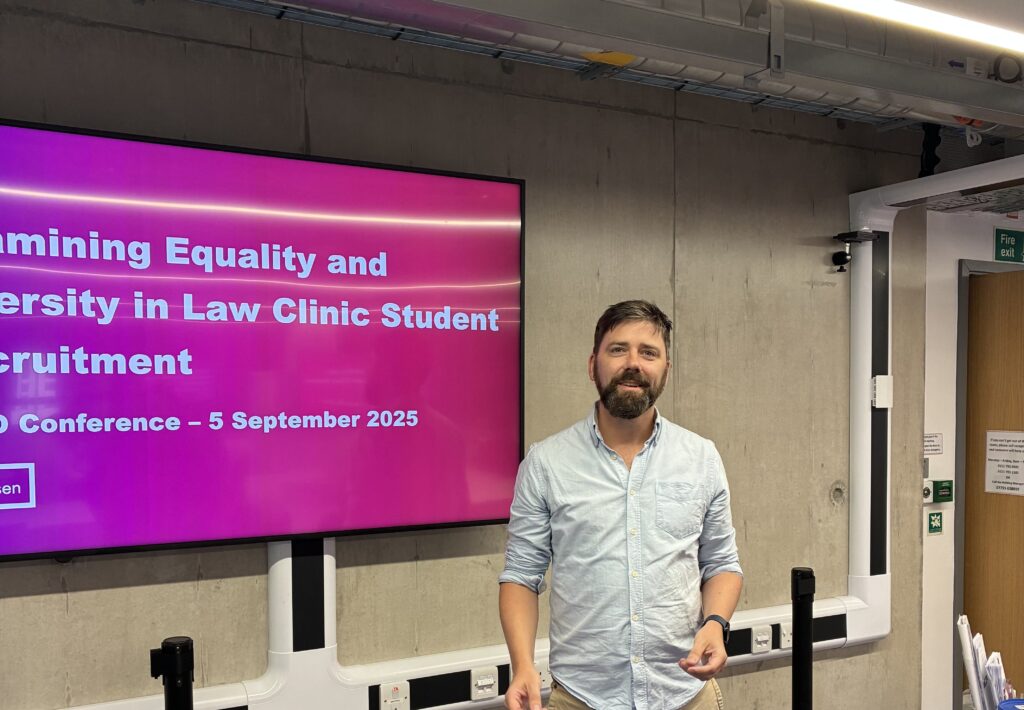
Our service evaluation applied a straightforward demographic comparison to three years of recruitment data from the Essex Law Clinic, examining the profile of applicants and those accepted against the broader law school student population. We applied this comparison across the four variables described above, using POLAR4, an area-based measure of participation in higher education, where data permitted. This kind of demographic comparison is standard practice in widening participation work across higher education, but has received little attention in the context of law clinic recruitment. Part of the contribution of this evaluation is to demonstrate how it can be applied in this context and what it reveals. We presented our methodology and reflections at the Clinical Legal Education Organisation conference in Liverpool in September 2025, and the response from colleagues suggests that the sector is ready to engage with these questions.
What It Means in Practice
If the primary equity concern lies at the application stage rather than in the selection process, the most productive interventions are likely to be on the demand side: making sure that application materials do not inadvertently signal that the clinic is intended for a particular type of student; offering information and preparation sessions open to all eligible students; and making the diversity of current participants visible. These are not radical changes, but they take seriously the possibility that some students are not applying because they do not see the clinic as for them – and that this is something clinics have the power to address. Continued attention to the selection process itself also remains warranted, even where the evidence suggests its influence is more modest.
The timing of recruitment may also matter. First-year students in particular may need time to settle into university life and build the confidence to take on additional commitments alongside their studies, something that may affect students from less advantaged educational backgrounds disproportionately. Considering when in the academic year the clinic recruits, and whether earlier outreach might help students feel ready to apply by the time the window opens, is worth exploring.
An Invitation
We are developing plans for a comparative study across multiple UK law clinics with different demographic profiles and different recruitment processes, and are building a network of potential collaborators. If your clinic would be interested in exploring involvement in the design and development of that project, or if you simply want to know more about the methodology we have developed, please get in touch with Lee Hansen at l.hansen@essex.ac.uk. The social justice mission of law clinics is one of the things that makes working in clinical legal education meaningful. That mission should extend all the way to the question of who gets through the door.